
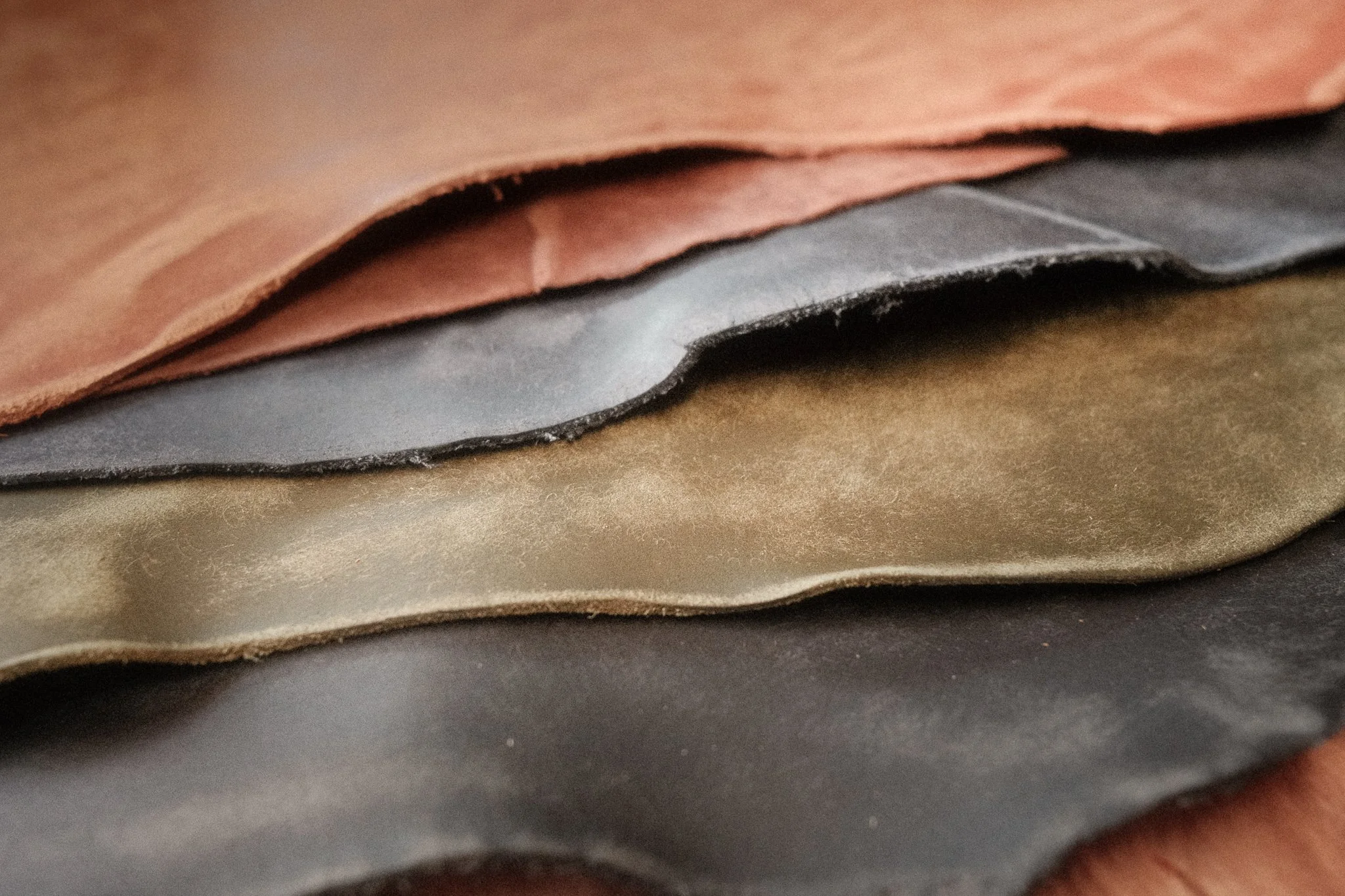
Badalassi Carlo - Pueblo Leather Hides
Most leather you come across was tanned in about a day. Chrome tanned leather is made in a faster, more uniform, and cheaper process. It's the right material for the job in plenty of cases. It's not the one I choose to use. I prefer vegetable tanned leather, for more than a few reasons.
Vegetable tanned leather is a slow, deliberate process, utilizing tree tannins instead of chemicals, and it hasn't changed much in hundreds of years. Hides sit in a bath of vegetable extracts and tree bark for days, then dry for even more time. From there, they're processed and finished by hand to develop characteristics chrome tanned leather could never possess.
The specific leather I use is called Pueblo, one of the articles from Badalassi Carlo, in Ponte a Egola, a small village in Tuscany. They've been making vegetable-tanned leather there for more than forty years, one of roughly twenty tanneries certified by the Consorzio Vera Pelle Italiana Conciata al Vegetale, the Genuine Italian Vegetable-Tanned Leather Consortium. Badalassi Carlo is a small, independent tannery that doesn't compromise on process or quality.
After it's tanned, it's milled into a subtle matte finish with a textured surface, and aniline dyed all the way through, rather than top coated, so a scratch shows the same color underneath. New, it looks fairly unassuming but give it time.
Then you carry it. Day after day, year after year, the matte surface picks up the oils from your hands, the places you touch most begin to polish, and it begins to darken from the sun. The piece ends up echoing where it's been and how it's used, something I could never replicate at the bench. Only you and time can. Chrome tanned leather doesn't get this chance. It's finished to look the same on day one as it does months later, the opposite of what vegetable tanned leather is built to do. The consortium has their own words for what Pueblo does instead: the leather "absorbs the traces of our life."
The first time I got my hands on a piece of Badalassi Carlo Pueblo leather I knew this was something special. The texture, the feel, the richness, it all felt familiar and refined. The character it holds and the feeling it conveys when cut, stitched and crafted into a finished good was unlike any other. I knew this was a material worth committing to with Proper Supply Co.
I use various thicknesses of Pueblo leather, each one chosen for the good it's going into, how and where it gets used. Goods that get dragged around a course and are exposed to the elements for years need the body and structure of a heavier hide to survive. Goods that naturally live a life more protected, or folded, need to start out thinner, or they end up too bulky. That means keeping multiple weights of the same leather in every color in the shop instead of settling for one. I won't cut corners on the leather to save a few dollars. If that means the price is a bit higher, so be it.
Every leather piece ships with a certificate of authenticity tag from the consortium, serial coded and issued by the certifying body, not by me. It certifies that the leather was tanned to the consortium’s standards. The piece itself is cut, stitched and finished by hand here in Scituate, Massachusetts. Italian hide, American made.
The leather looks great on day one. Give it a month, a season, or years, and it only gets better. That's the whole reason I choose vegetable tanned leather and Badalassi Carlo.
-Made to wear in, not out-